
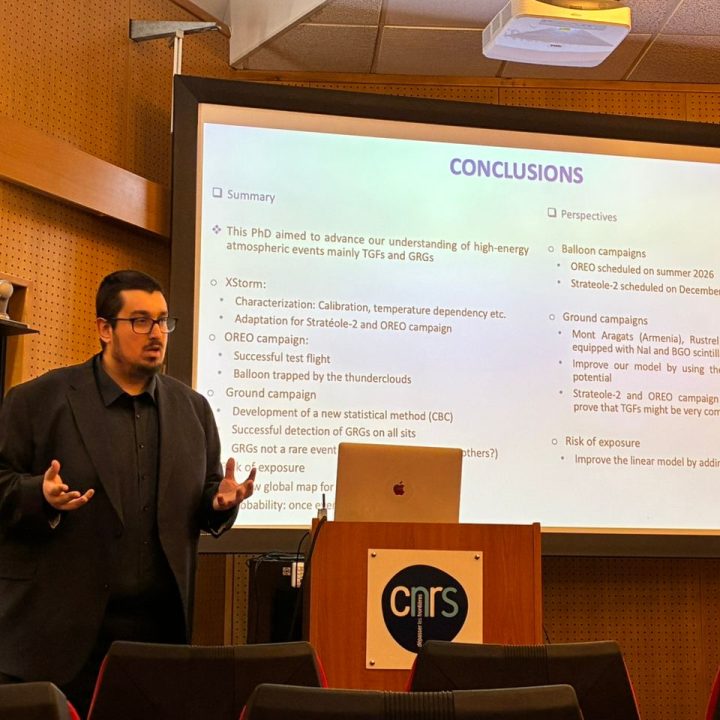
Le 11 février 2026, Yanis Hazem a brillamment défendu sa thèse intitulée « High-energy phenomena in thunderstorms: instrumentation, statistical inference, and risk assessment ». Bravo Yanis !
Résumé de la thèse :
Thunderstorms are powerful natural particle accelerators capable of producing high-energy radiation phenomena such as Terrestrial Gamma-ray Flashes (TGFs), Gamma-ray Glows (GRGs), and more recently identified Flickering Gamma-ray Flashes (FGFs). These phenomena result from the acceleration of electrons in strong electric fields within thunderclouds and remain a subject of active investigation due to their implications for atmospheric physics and potential radiation exposure to aviation.
This PhD thesis advances the understanding and detection of these high-energy atmospheric events through a combination of observation campaigns, developement of statistical methods, and risk assessment. A first part focuses on the XStorm gamma-ray spectrometer, composed of a BGO and a plastic scintillator, for which we quantified the temperature dependence of the BGO decay time, proposed a new Compton-edge calibration method for the plastic detector, and adapted its acquisition software for future balloon missions such as Stratéole-2. XStorm was successfully deployed during the OREO balloon test flights, providing valuable in-flight performance data.
In the second part, we developed a new Bayesian inference method capable of revealing weak gamma-ray glows otherwise hidden under background noise. Applied to data from three ground-based stations (Chofu in Japan, La Hague and Pic du Midi in France), this method identified more than 14 glows, including several events too faint to be detected with traditional statistical techniques. The results indicate that GRGs are much more frequent than previously thought and may be a common feature of thunderstorm electrification.
Finally, we constructed a statistical model linking lightning occurrence (from OTD/LIS observations) and TGF detections by Fermi-GBM to produce a global proxy map of TGF density. The model estimates that approximately 520,000 TGFs all over the world detectable by Fermi-GBM occur per year, with 87% concentrated in the tropics.
Incorporating weak TGFs detected during the ALOFT campaign, we refined the estimated exposure risk for the global global fleet, finding that the probability of receiving more than 1 Sv dose is about once every 400 years, while exposure to more than 1 mSv may occur about once every 16 years.
Overall, this work bridges instrumentation, observation, and statistical inference to provide a new perspective of high-energy phenomena in thunderstorms and to constrain their implications for atmospheric electricity and aviation radiation safety.
Composition du jury :
Rapporteurs :
Joan MONTAÑA, Universitat Politècnica de Catalunya (BarcelonaTech)
Bagrat MAILYAN, Florida Institute of Technology
Examinateurs :
Thomas FARGES, CEA
Yasuhide HOBARA, Graduate School of Informatics and Engineering
Matthieu KRETZSCHMAR, Université d’Orléans, LPC2E
Directeurs de thèse :
Sébastien Celestin, Université d’Orléans, LPC2E
François Trompier, Autorité de Sûreté Nucléaire et de Radioprotection